
Concurrency Benchmarking
Sequential benchmarks measure raw execution speed in isolation. However, asynchronous applications (FastAPI endpoints, message queues, MCP tool servers) primarily operate under concurrent load.
Under concurrency, coroutines contend for CPU slices, connection pools, and event-loop time. async_benchmark.concurrent() tests how your code performs when multiple operations are in flight simultaneously.
Basic Usage
Call async_benchmark.concurrent() with:
concurrency: Maximum number of coroutines running concurrently.total: Total number of invocations to complete.timeout(optional): Maximum per-call timeout in seconds.leak_check(optional): Check for unawaited orphan tasks.
import asyncio
import pytest


async def handle_request(client_id: int):
    # Simulate database query and serialization
    await asyncio.sleep(0.005)
    return {"status": "ok", "client": client_id}


@pytest.mark.asyncio
async def test_under_load(async_benchmark):
    # 20 requests in flight simultaneously, 200 total requests
    stats = await async_benchmark.concurrent(
        handle_request,
        client_id=1,
        concurrency=20,
        total=200,
    )

    print(f"Throughput: {stats.ops:.1f} ops/sec")
    print(f"Median: {stats.median * 1000:.2f} ms")
    print(f"95th percentile: {stats.p95 * 1000:.2f} ms")
    print(f"99th percentile: {stats.p99 * 1000:.2f} ms")
    print(f"Loop Lag: {stats.loop_lag * 1000:.2f} ms")

    assert stats.errors == 0
    assert stats.timeouts == 0
    assert stats.p95 < 0.015  # Under 15ms under load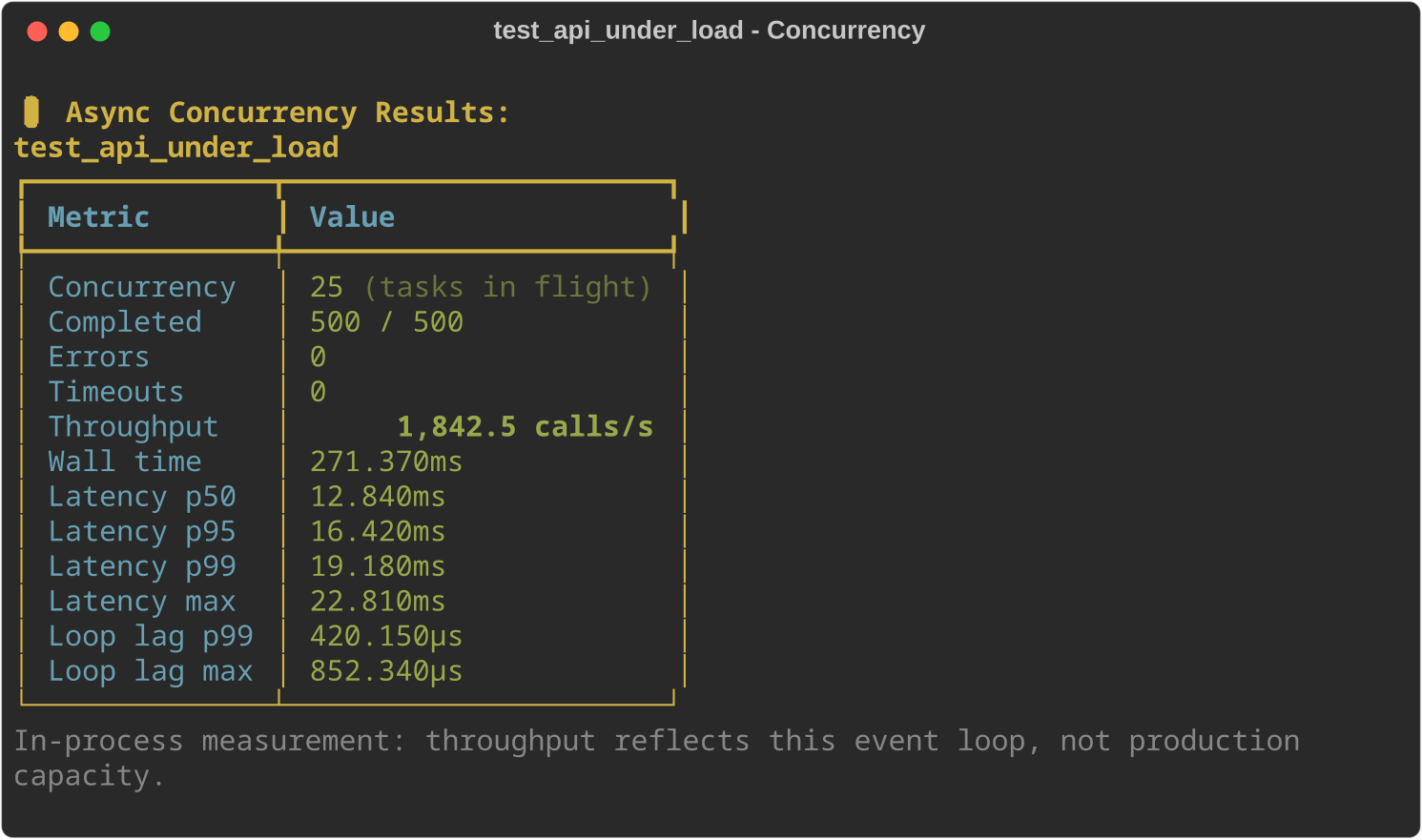
Result Fields: ConcurrentBenchmarkResult
The returned result object provides comprehensive load performance data:
| Attribute | Type | Description |
|---|---|---|
ops | float | Throughput in operations per second (completed / total_time) |
total_time | float | Total elapsed wall-clock duration in seconds |
concurrency | int | Maximum concurrent calls in flight |
total | int | Target number of total calls |
completed | int | Successfully finished calls |
errors | int | Number of calls that raised exceptions |
timeouts | int | Number of calls that timed out |
loop_lag | float | Maximum event-loop scheduler delay in seconds |
mean | float | Mean duration per call |
min | float | Minimum call duration |
max | float | Maximum call duration |
median | float | Median (50th percentile) duration |
p50 | float | 50th percentile latency |
p75 | float | 75th percentile latency |
p90 | float | 90th percentile latency |
p95 | float | 95th percentile latency |
p99 | float | 99th percentile latency |
samples | list[float] | Individual latency durations for all completed calls |
Error and Timeout Handling
When benchmarking flaky network services or connection pools under heavy load, calls may fail or time out. pytest-async-benchmark tracks these explicitly without crashing the benchmark run:
@pytest.mark.asyncio
async def test_resilience(async_benchmark):
    stats = await async_benchmark.concurrent(
        flaky_network_call,
        concurrency=50,
        total=500,
        timeout=0.05,  # 50ms deadline
    )

    # Assert that errors remain within SLA limits:
    error_rate = (stats.errors + stats.timeouts) / stats.total
    assert error_rate < 0.02  # Less than 2% failure rate
If all calls fail, the runner raises a RuntimeError with details of the underlying exception.
Measuring Event Loop Lag
Asynchronous Python runs on a single OS thread via cooperative multitasking. If a handler performs synchronous blocking operations (e.g. time.sleep(), heavy hashing, regexes without yielding), it starves all other coroutines on the loop.
During concurrency runs, pytest-async-benchmark runs a background timer measuring how far the loop drifts from its target schedule.
assert stats.loop_lag < 0.005 # Loop lag should stay under 5msA high loop_lag warns you that CPU-bound code is choking your event loop and should be offloaded to asyncio.to_thread() or ProcessPoolExecutor.