
Comparative Benchmarking
When optimizing asynchronous systems, you often need to evaluate competing implementations: comparing two serialization formats, evaluating different caching libraries, or tuning batch sizes.
pytest-async-benchmark provides high-level comparison utilities:
a_vs_b_comparison: Quick side-by-side comparison of two implementations.quick_compare: Dictionary-based comparison of multiple implementations.BenchmarkComparator: Full multi-scenario analysis with rankings and Rich tables.
A vs B Comparisons
Compare two coroutines with a single function call:
python
import asyncio
import pytest
from pytest_async_benchmark import a_vs_b_comparison


async def approach_a():
    await asyncio.sleep(0.005)


async def approach_b():
    await asyncio.sleep(0.002)


@pytest.mark.asyncio
async def test_implementation_bakeoff():
    winner, diff_pct, (res_a, res_b) = await a_vs_b_comparison(
        approach_a,
        approach_b,
        rounds=10,
        iterations=5,
    )

    print(f"Winner: {winner}")
    print(f"Performance Difference: {diff_pct:.1f}%")

    assert winner == "approach_b"
    assert diff_pct > 50.0  # Approach B is over 50% faster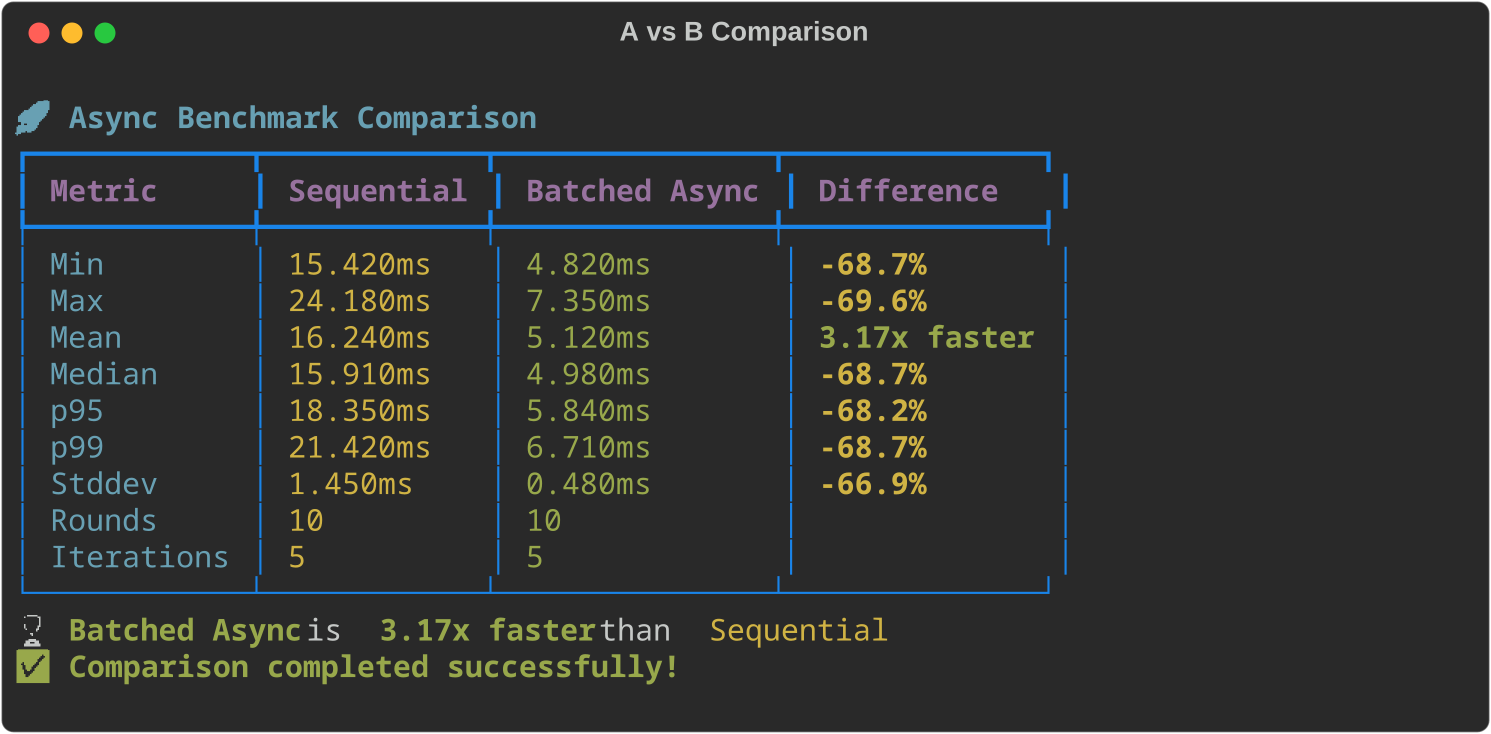
Quick Compare (Dictionary of Scenarios)
To compare three or more implementations simultaneously:
python
import asyncio
import pytest
from pytest_async_benchmark import quick_compare


async def parse_sync():
    await asyncio.sleep(0.008)


async def parse_threads():
    await asyncio.sleep(0.004)


async def parse_native():
    await asyncio.sleep(0.001)


@pytest.mark.asyncio
async def test_parser_options():
    results = await quick_compare(
        {
            "Sync Parser": parse_sync,
            "Threaded Parser": parse_threads,
            "Native Async": parse_native,
        },
        rounds=10,
    )

    fastest = min(results.items(), key=lambda x: x[1]["mean"])
    assert fastest[0] == "Native Async"
Advanced Multi-Scenario Analysis (BenchmarkComparator)
For complex comparative experiments, use BenchmarkComparator:
python
import asyncio
import pytest
from pytest_async_benchmark import BenchmarkComparator


@pytest.mark.asyncio
async def test_detailed_suite():
    comparator = BenchmarkComparator()

    comparator.add_scenario(
        "Standard JSON",
        parse_sync,
        description="Standard library json module",
    )
    comparator.add_scenario(
        "Orjson",
        parse_native,
        description="Fast Rust-based orjson",
    )

    results = await comparator.run_all(rounds=15)

    # Determine fastest implementation
    fastest_name, fastest_data = comparator.get_fastest()
    assert fastest_name == "Orjson"

    # Determine most stable (lowest relative standard deviation)
    stable_name, stable_data = comparator.get_most_stable()

    # Pretty-print comparison table
    comparator.display_table()